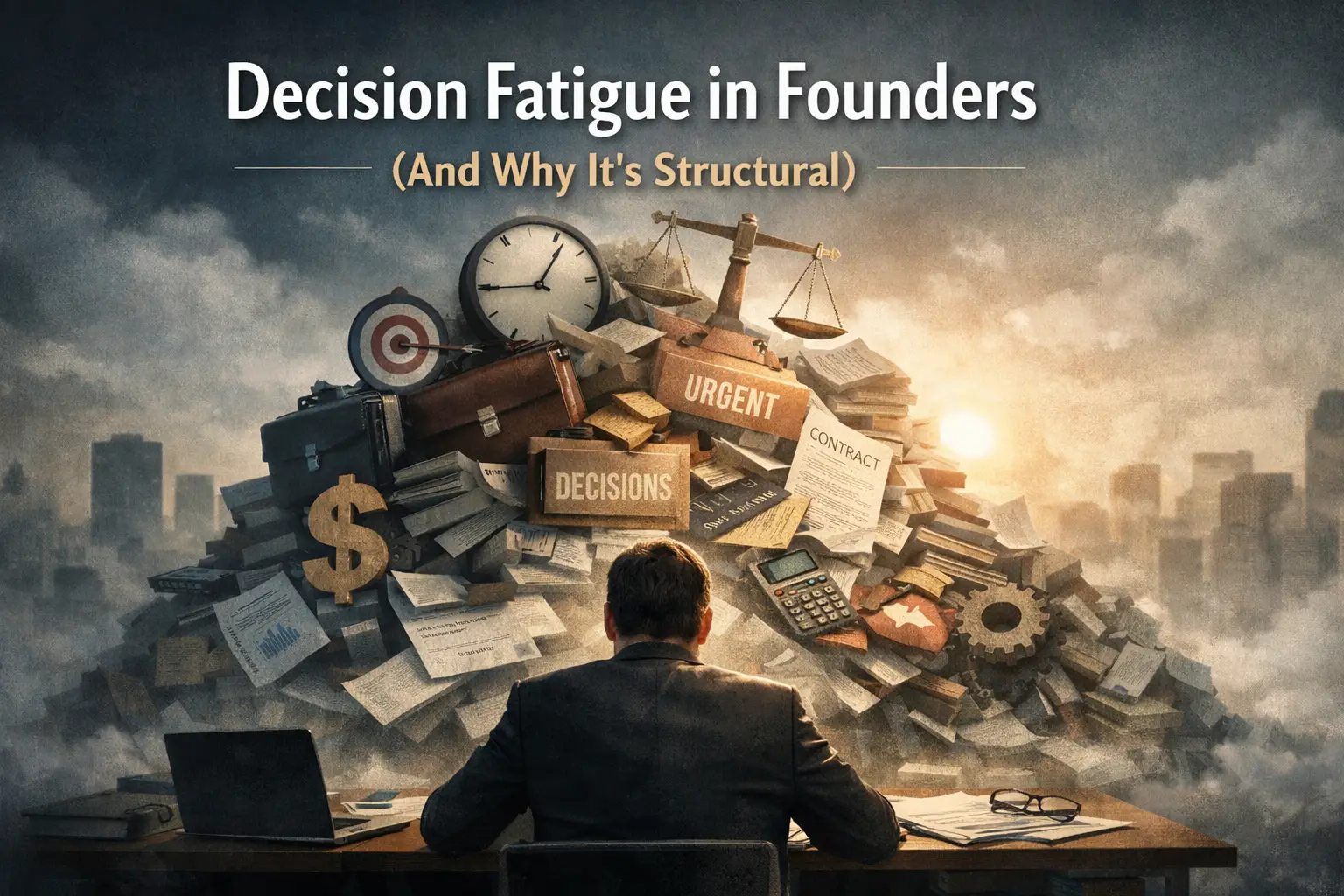
Decision fatigue in founders rarely announces itself as a crisis. It shows up as slower mornings, longer pauses before simple replies, and a quiet sense that everything now requires more effort than it should. Owners who once trusted their judgment begin second‑guessing routine calls. Calendar space shrinks while cognitive weight expands. The business is often healthy on paper – revenue is rising, demand is steady, the team is growing – yet the operator feels increasingly stretched by the act of making all the decisions themself.
This experience is commonly misdiagnosed as a personal productivity issue. Business owners assume they need better habits, stronger discipline, or sharper focus. In reality, what they are encountering is structural business risk emerging from their business becoming more complex as it grows. As organizations grow, decision volume multiplies faster than most operating systems evolve. More clients create more exceptions. More employees create more interpretation gaps. More revenue introduces higher‑stakes tradeoffs. Without deliberate decision architecture for business owners, judgment becomes the bottleneck that constrains everything else.
This article reframes founder decision fatigue as an operational design problem rather than a personal limitation. We will examine how reactive leadership patterns form, what quietly breaks when decision load compounds, and how structured decision environments restore clarity and control. The goal is not motivation. It is recognition. When structure improves, cognitive weight falls naturally, and leadership becomes steady again.
Table of Contents
The Quiet Weight Most Founders Don’t Talk About
Every experienced owner recognizes the feeling of carrying decisions that never fully leave their mind. It is the mental equivalent of background noise – pricing questions, hiring calls, client exceptions, capital timing, and the subtle calculation of risk in every conversation. This business owner’s mental load builds gradually, which is why it often escapes attention until exhaustion feels normal. Nothing dramatic happens. The weight simply accumulates.
What makes this difficult is that outward success masks inward friction. A firm generating $1.8M in revenue can look stable while the founder privately absorbs hundreds of micro‑decisions each week. Each one feels small in isolation. Together they form a continuous cognitive tax. This is where decision fatigue in founders takes root – not from crisis, but from accumulation without structural release.
This emotional experience is often misread as a business owner “losing their edge.” In reality, the operator is encountering a system that now produces more judgment calls than its architecture can support. The problem is not their capabilities. It is their output. Just as a building designed for two floors struggles under ten, a business designed for early survival strains under growing complexity.
This Is Not a Productivity Problem
Most advice aimed at founder burnout from decisions focuses on personal efficiency. Time blocking, morning routines, delegation tips, and focus frameworks dominate the conversation. These tools can help at the margin, but they do not address the structural mechanics creating the pressure. When decision flow exceeds structural capacity, personal discipline becomes a temporary patch rather than a durable solution.
Consider what actually changes as a service business grows. Client engagements become less uniform. Pricing conversations require judgment rather than a formula. Team members interpret processes differently. Strategic choices carry greater financial consequences. None of this can be solved with a better to‑do list because the issue is not task management. It is decision management.
As a business grows and begins to feel overwhelmed, it often faces what engineers refer to as a load imbalance. The root issue is that the systems of authority, rules, and escalation were never updated to handle the increased scale. This leaves the founder stuck as the main problem-solver for uncertainties. Simply using productivity tools isn’t enough to fix this, and no matter how efficiently you manage or organize something, if the underlying foundation is flawed, the system will eventually fail.
How Reactive Decision Environments Form
Reactive leadership patterns rarely begin intentionally. They emerge from early‑stage survival behaviors that once served the business well. Founders respond quickly to clients, make exceptions to close deals, step into role-gaps in their operations, and personally resolve uncertainty. These actions build trust and momentum in the beginning. Over time, however, they also create invisible precedents.
Each exception becomes an unwritten policy. Each rescue becomes an expected escalation path. Each fast decision trains the organization to defer upward. Eventually, the business conditions the founder to remain the central interpreter of complexity. What began as responsiveness evolves into dependence.
This environment accelerates during growth because complexity compounds faster than control. More clients introduce more variation. More staff introduces more interpretation. More revenue raises the stakes on every call. Without explicit decision architecture, the system defaults to human judgment at the top, which is the most expensive and least scalable processing unit available.
What Breaks First (And What Breaks Quietly)
When a business owner’s decision fatigue intensifies, failure rarely appears as a dramatic collapse. Instead, erosion occurs in subtle operational layers. Strategic thinking shortens. Pricing confidence weakens. Hiring decisions are delayed. Capital investment and timing become cautious. None of these feel catastrophic in isolation, yet together they slow your business’s momentum.
The first casualty is usually decision quality under time pressure. Fatigued leaders default to familiar options, avoid necessary risk, or postpone important calls. The second is cultural clarity. Teams sense hesitation and begin escalating more frequently, reinforcing the cycle. The third is the strategic horizon, when long‑term design becomes secondary to short‑term responses.
This progression creates downstream structural business risk that compounds quietly. Opportunities pass. Margins narrow. Talent stalls. Competitors with clearer governance move faster. The organization appears functional while gradually losing adaptive strength. The danger is not immediate failure. It is a slow drift away from your intentional direction.
Installing Decision Architecture
Restoring control requires more than delegation or documentation. It requires installing structural guardrails that govern how decisions form, travel, and are resolved inside the business. Decision architecture for business owners functions like load‑bearing beams inside a building. It distributes weight so the structure remains stable as complexity increases.
This work is not theoretical. It is a practical design applied to recurring judgment zones where business owners currently absorb too much mental load. The goal is not to remove the owner from important decisions. It ensures their attention is reserved for decisions that genuinely require their experience.
Capital Allocation Guardrails
Financial decisions often represent the highest friction because they combine risk, uncertainty, and future consequences. Without guardrails, every investment feels unique and emotionally loaded. Business owners replay scenarios repeatedly, which drains clarity and slows action.
Capital allocation guardrails establish thresholds, categories, and decision rights before opportunities arise. For example, defining reinvestment percentages, acceptable risk bands, and approval levels transforms ambiguous financial calls into structured evaluations. The owner still exercises judgment, but within a designed frame that reduces cognitive strain and improves consistency.
Pricing Rules
Pricing becomes a major source of business owner decision fatigue as client variation increases. Exceptions feel relationally necessary yet structurally destabilizing. Over time, pricing turns into a negotiation theater that pulls leaders into repeated micro‑analysis.
Rulesets turn pricing from being made up on the spot into having some flexible boundaries. Clear discount parameters, value‑based tiers, and exception protocols allow teams to operate autonomously and confidently while preserving strategic control. This reduces both mental load and eroding margins. The system absorbs variability, so the founder does not have to.
Authority Mapping
Many organizations confuse delegation with authority design. Tasks move downward while decision rights remain ambiguous. This forces issues back upward whenever uncertainty appears, which sustains overload regardless of headcount growth.
Authority mapping clarifies who decides what, under which conditions, and with what escalation triggers. It transforms hierarchy into a decision network where responsibility and judgment align. The business owner’s role shifts from constant interpreter to structural steward, a position that preserves energy while strengthening organizational confidence.
Advisor Coordination
External advisors often increase decision fatigue when their input arrives without integration. Accountants, attorneys, consultants, and coaches each provide valid perspectives, yet founders must reconcile competing guidance alone. The cognitive work of synthesis becomes invisible but heavy.
Coordinated advisory structures align inputs around strategic priorities and sequencing. Decisions flow through a coherent framework rather than fragmented conversations. This restores clarity and prevents expertise from becoming noise.
Reactive Leadership vs Structured Leadership
The contrast between reactive and structured leadership is not philosophical. It is operational and observable in daily decision flow. Reactive systems concentrate interpretation at the top, depend on memory rather than design, and handle each situation as unique. Structured systems share decision-making on purpose, use set guidelines, and keep escalation for truly unclear situations.
Reactive leadership feels fast in the moment but unstable over time. Structured leadership feels deliberate in the moment but accelerates sustainably. One depends on personal endurance. The other depends on engineered clarity.
Founders often fear that structure will slow responsiveness or dilute relational depth. In practice, the opposite occurs. When routine decisions follow a systematic structure, leaders regain themental space required for empathy, creativity, and strategic thought. Structure protects humanity rather than constraining it.
The Maturity Divide in Growing Businesses
A clear difference separates firms that struggle under complexity from those that manage it smoothly. Early-stage businesses depend on quick decisions because survival requires speed. In contrast, mature businesses depend on structured systems because stability requires repeatable processes. This transition isn’t always obvious, but it is very important.
Organizations that don’t adapt often mistake internal friction for market issues, rather than recognizing it as a problem with their structure. They just add more staff, tools, and activities without changing how they make decisions. This leads to more confusion and wears out leaders even as the company seems to grow.
Firms that make this transition well focus on strong governance as a foundation. They understand that as their business grows, their processes need to evolve too. Proper decision-making processes become key to building resilience, not just another task to check off.
This is exactly where my Strategic Business Partner solution becomes crucial. It’s a more involved partnership for experienced Business Owners who need integrated decision-making systems, not just advice. It focuses on creating decision environments that support the weight of complexity, allowing founders to lead without feeling overwhelmed.
Ways I Can Help
Decision fatigue in business owners is often interpreted as a personal signal when it is actually a structural message. The business is not asking for more effort. It is asking for a better design. Complexity is not the enemy of leadership. Unstructured complexity is.
When decision flow aligns with governance, clarity returns naturally. Energy stabilizes. Teams gain confidence. Strategic thinking expands again. The founder does not become less involved. They become involved where their judgment matters most.
If this experience feels familiar, the next step is not urgency but examination. Consider whether your current operating structure distributes decision weight intentionally or concentrates it by default. Structural clarity installed early prevents downstream risk that becomes harder to unwind later.
You can schedule a Strategic Conversation or explore our Business Assessment approach here: https://allenarchuleta.com/business-assessment/
This is not about discipline. This is about structure.