The Hidden Cost of Running a Reactive Business: How Revenue Masks Structural Risks
Revenue is coming in, clients are lined up, and advisors are on call. Yet, your mental load is heavier than ever. Cash feels unpredictable, decisions wear on you emotionally, and growth only adds complexity instead of stability. This is what running a reactive business looks like: a functioning but fragile business where the hidden cost of reactivity quietly builds structural risks beneath the surface.
Functioning, But Fragile
Your business appears healthy on the surface. Clients continue to sign contracts. Revenue flows in regularly enough. You have a bookkeeper, perhaps a CPA, and maybe even legal counsel. From the outside, everything looks fine.
But internally, something feels off.
Cash availability swings unpredictably despite consistent revenue. Simple decisions now require exhausting mental calculations. Each new client adds complexity rather than stability. Nothing is failing outright, but nothing feels truly controlled either.
This is the reality of operating in the “Functioning but Fragile” phase – where your business runs, but lacks the structural foundation to support sustainable growth.
The Quiet Warning Signs
The warning signs of a functioning but fragile business aren’t dramatic:
-
You hesitate before checking account balances
-
Tax time brings consistent surprises
-
Pricing decisions feel arbitrary rather than strategic
-
Client dependencies create underlying anxiety
-
Growth conversations trigger stress instead of excitement
-
Your mental load increases with each new client
A business running reactively doesn’t announce its fragility with sirens. Instead, it slowly drains your clarity, confidence, and control while still producing revenue.
How Reactive Businesses Form
Reactive businesses rarely start that way. They evolve into reactivity through four common patterns:
-
Speed over structure: Making quick decisions to capture opportunities without establishing operational foundations.
-
Opportunistic growth: Saying yes to available work rather than intentional client selection.
-
Advisor silos: Having professionals who handle isolated aspects of your business without integration.
-
Delayed structural clarity: Postponing fundamental decisions about business architecture while focusing on immediate revenue.
What’s particularly challenging is that none of these patterns feel wrong in the moment. Each seems like the practical choice when you’re building momentum. Each can be justified as “what businesses do to grow.”
But collectively, they create a business that runs you, rather than a business you run with intention.
The Quiet Compounding of Structural Risk
The true cost of reactivity isn’t stress or overwork – though those are real. The actual price is paid through structural risk that compounds quietly in five critical areas:
Pricing Drift
In reactive businesses, pricing becomes increasingly disconnected from strategy. You might price based on:
-
What feels comfortable asking for
-
What competitors charge
-
What the last similar client paid
-
What you need to cover this month’s expenses
Without clear pricing logic and discipline, each new client negotiation becomes its own isolated event. Over time, this creates a client roster paying vastly different rates for similar work, making revenue planning nearly impossible.
Cash Flow Unpredictability
Business cash flow unpredictability stems directly from reactive operations. Without structured visibility into your money patterns, you face:
-
Inconsistent owner compensation
-
Unexpected tax obligations
-
Resource allocation guesswork
-
Difficulty planning for investments
-
Stress-based financial decisions
Many founders mistake cash flow problems for revenue problems, when they’re actually structural visibility problems.
Advisor Silos
Most founders have advisors – accountants, attorneys, consultants. But in reactive businesses, these advisors operate in isolation without coordinated strategy.
Your CPA focuses on financials and compliance without visibility into your growth plans. Your attorney drafts contracts without understanding your pricing strategy.
This creates a fractured decision ecosystem where each advisor’s good advice might conflict with another’s guidance.
Decision Fatigue
Perhaps the most insidious cost of running a reactive business is decision fatigue. Without clear frameworks, each choice becomes a new mental calculation:
-
Can we afford this hire?
-
Should we take this client?
-
Is this the right time to invest?
-
How much should I pay myself this month?
When every decision requires fresh analysis, your mental bandwidth depletes rapidly. This leads to delayed decisions, second-guessing, and the subtle anxiety of never quite knowing if you’re making the right call.
Why Revenue Masks Instability
Good founders miss these warning signs for one primary reason: revenue creates the illusion of stability.
When money comes in regularly, it’s easy to assume your business is fundamentally sound. Revenue becomes both validation and distraction – confirming you’re doing something right while diverting attention from structural weaknesses.
This isn’t a founder capability issue. It’s an attention allocation problem. Your focus naturally goes to revenue-generating activities rather than structural foundation work that doesn’t immediately impact the top line.
The problem compounds because:
-
Clients continue to sign despite structural issues
-
Referrals still come despite internal chaos
-
Bills still get paid despite cash flow unpredictability
By the time structural problems become obvious, they’ve often grown from fixable issues into complex entanglements requiring significant effort to resolve.
The Control Reframe
Addressing business fragility requires a fundamental reframe: control in your business is not natural – it must be installed.
This isn’t about:
-
Working harder
-
Being more disciplined personally
-
Having better time management
-
Getting the right mindset
It’s about installing proper operating architecture – the structural elements that allow a business to function with predictability and clarity regardless of who’s at the helm or what market conditions exist.
Control comes from:
-
Replacing assumptions with facts
-
Installing money visibility before scaling
-
Defining pricing rules before adding volume
-
Sequencing structural decisions intentionally
-
Creating decision guardrails before complexity increases
What Installed Control Actually Looks Like
Installed control manifests through five specific structural elements:
1. Money Visibility Model
A clear system showing exactly how money moves through your business, when it’s available, and what patterns exist in your cash flow. This goes beyond standard accounting reports to create founder-relevant financial clarity.
2. Pricing Ruleset
A documented framework governing how you price work, when you adjust rates, which clients receive which pricing, and what exceptions are permitted. This eliminates the mental load of pricing decisions.
3. Decision Matrix
A structured approach to making consistent decisions about clients, team, investments, and growth based on predetermined criteria rather than in-the-moment judgment.
4. Operating Flow Map
A visual representation of how work, information, and decisions move through your business, identifying friction points and opportunities for streamlining.
5. Risk Guardrails
Clearly defined boundaries around client concentration, cash reserves, debt utilization, and growth pacing to prevent overextension.
These elements aren’t abstract concepts – they’re tangible business assets that, once installed, create the foundation for controlled growth.
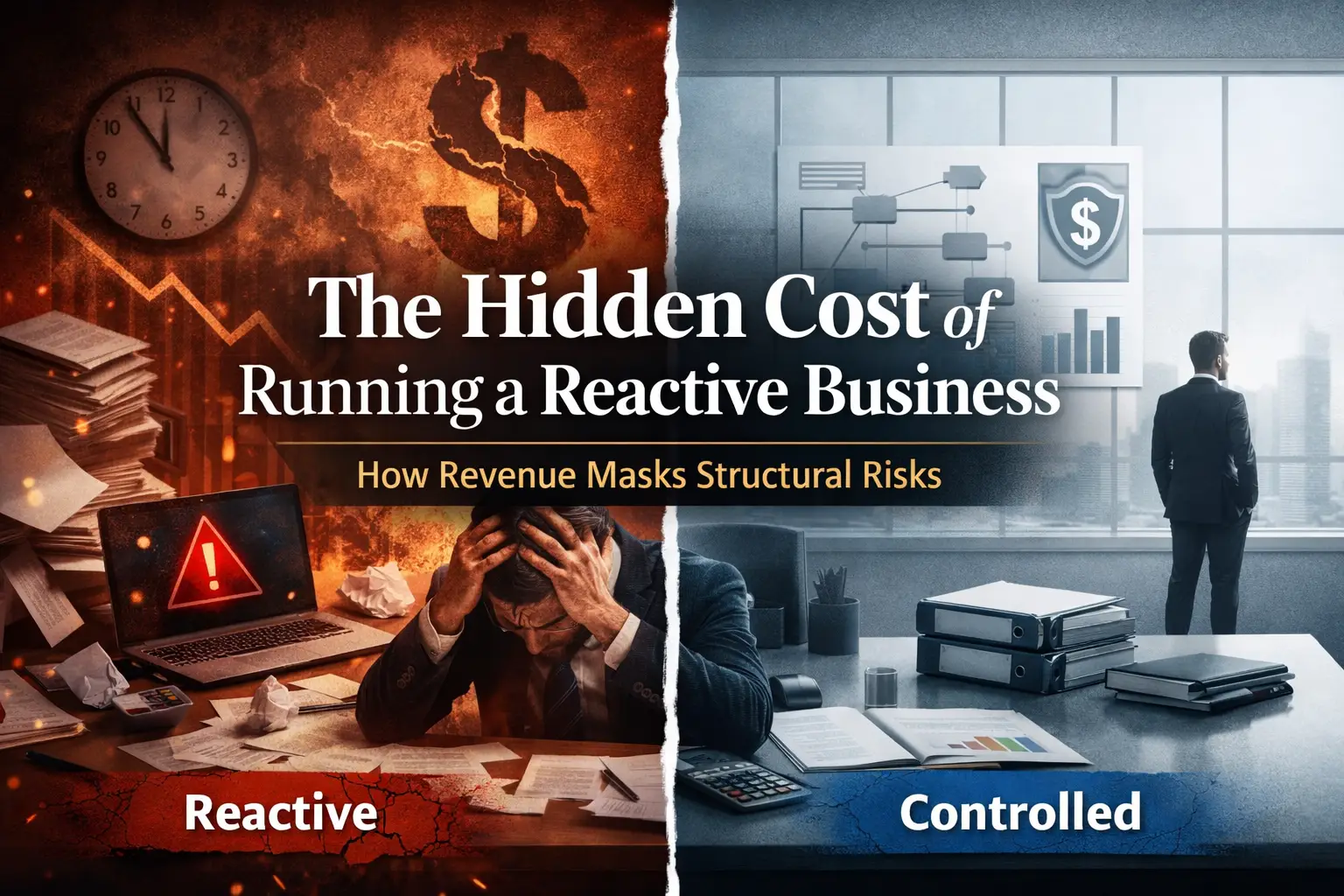
Reactive vs Controlled: The Maturity Divide
The difference between reactive and controlled businesses becomes clear when viewing them side by side:
Reactive Business:
-
Decisions based on immediate needs
-
Cash flow that surprises regularly
-
Pricing determined case-by-case
-
Growth that adds complexity
-
Founder as primary decision bottleneck
-
Advisors working in isolation
Controlled Business:
-
Decisions based on established criteria
-
Cash flow that follows visible patterns
-
Pricing governed by clear rules
-
Growth that adds stability
-
Systems that support decision-making
-
Integrated advisory approach
This isn’t about business size or revenue. Many larger businesses operate reactively, while some smaller ones function with remarkable control. The difference lies in the underlying operating architecture.
Control Before Complexity
The most challenging aspect of moving from reactivity to control is timing. The ideal moment to install structural elements is before you need them – before complexity compounds further.
This requires a counterintuitive approach: slowing down strategically to establish control before accelerating growth. For many founders, this feels uncomfortable. The revenue is coming in. Opportunities exist. Why pause to build structure?
Because the cost of retrofitting structure into an already complex business is exponentially higher than installing it early. Each new client, team member, service line, or revenue stream you add without proper architecture multiplies the eventual work required.
The business that feels chaotic but profitable today becomes increasingly difficult to organize tomorrow. The pricing mistakes in growing business compound with each new client agreement. The structural business risk accumulates silently until it suddenly becomes visible – often at the least convenient moment.
Installing control isn’t about restricting growth – it’s about creating the conditions for sustainable, predictable growth without the founder decision fatigue and business fragility that typically accompany expansion.
For revenue-producing founders experiencing the subtle anxiety of running a functioning but fragile business, the path forward isn’t working harder within the current structure. It’s installing the proper operating architecture that allows your business to grow with intention rather than reaction.
The Chaos-to-Control Framework provides a structured approach to this installation process, helping founders move from reactivity to control before complexity compounds further.
Your business isn’t failing. But it is running reactively. And that’s costing more than you realize.